2.1 - The Ozone Layer
Scientific verification date: August 6, 2026
Primary authorities: Current U.S. Environmental Protection Agency ozone-layer science resources, the 2022 Scientific Assessment of Ozone Depletion, and current NASA atmospheric-science resources
Course role: Establishes the atmospheric and ultraviolet-radiation concepts needed to understand ozone depletion, refrigerant environmental effects, and the federal refrigerant-management requirements developed later in Module 2
Learning Objectives
After completing this section, a student should be able to:
- Define ozone and distinguish it from ordinary molecular oxygen.
- Distinguish ground-level ozone from stratospheric ozone.
- Explain how the stratospheric ozone layer protects life from ultraviolet radiation.
- Compare the atmospheric behavior of ultraviolet A, ultraviolet B, and ultraviolet C radiation.
- Identify major human-health, ecosystem, and material effects associated with depletion of the stratospheric ozone layer.
- Explain why ozone-layer science is relevant to EPA Section 608 refrigerant-management requirements.
Introduction
Ozone is the same chemical substance wherever it occurs, but its effect depends strongly on its location in the atmosphere.
Near the Earth’s surface, ozone is a harmful air pollutant and an important component of smog. Higher in the atmosphere, most atmospheric ozone is concentrated in the stratosphere, where it forms the ozone layer. This stratospheric ozone absorbs much of the Sun’s biologically damaging ultraviolet radiation before that radiation reaches people, plants, animals, and materials at the Earth’s surface.
The environmental purpose of many refrigerant-management requirements cannot be understood without this distinction. Certain chemicals historically used as refrigerants are stable enough to reach the stratosphere, where they can participate in reactions that reduce the amount of protective ozone. The detailed ozone-depletion chemistry is developed in Section 2.2 - Ozone Depletion Process.
This section first establishes what ozone is, where the ozone layer is located, what ultraviolet radiation it absorbs, and why loss of stratospheric ozone is harmful.
Key Concepts
1. Ozone Is a Three-Atom Form of Oxygen
Ordinary molecular oxygen is written as because each molecule contains two oxygen atoms.
Ozone is written as because each molecule contains three oxygen atoms.
| Substance | Chemical Formula | General Atmospheric Role |
|---|---|---|
| Molecular oxygen | Essential atmospheric gas; also participates in natural ozone formation | |
| Ozone | Reactive trace gas that is beneficial in the stratosphere but harmful when breathed near the ground |
Ozone is much more reactive than ordinary molecular oxygen. This reactivity helps ozone absorb ultraviolet radiation in the stratosphere, but it also makes ground-level ozone harmful to lung tissue and sensitive vegetation.
The ozone layer is not a solid shell and is not made of pure ozone. It is a broad region of the stratosphere containing a greater concentration of ozone than the surrounding atmosphere. Even within this region, ozone remains a trace gas.
2. The Atmosphere Is Divided Into Layers
The two atmospheric layers most important to this section are the troposphere and the stratosphere.
| Atmospheric Region | Approximate Altitude | Important Characteristics |
|---|---|---|
| Troposphere | Surface to about | Contains most weather, people, buildings, and most ordinary human activity |
| Stratosphere | About to | Contains most atmospheric ozone and has less vertical mixing than the troposphere |
| Ozone-rich region | Approximately to | Contains the bulk of the ozone layer and absorbs harmful ultraviolet radiation |
These altitude ranges are approximate. Atmospheric boundaries vary with latitude, season, and atmospheric conditions. For EPA 608 preparation, the important distinction is not one exact altitude. It is that:
- Ground-level ozone is in the troposphere near where people breathe.
- Protective ozone is concentrated much higher, in the stratosphere.
EPA states that about 90 percent of atmospheric ozone is in the stratospheric ozone layer.
3. Ground-Level Ozone and Stratospheric Ozone Have Different Effects
The phrase good ozone up high and bad ozone nearby is a useful memory aid, provided the student understands that both are chemically .
| Comparison | Stratospheric Ozone | Ground-Level Ozone |
|---|---|---|
| Location | Stratosphere | Troposphere near the Earth’s surface |
| Main role | Absorbs harmful solar ultraviolet radiation | Acts as an air pollutant |
| Effect on people | Protects against excessive ultraviolet exposure | Can irritate and damage the respiratory system |
| Effect on plants | Helps protect plants from excessive ultraviolet radiation | Can damage sensitive vegetation and reduce growth |
| Common description | Protective ozone layer | Major component of smog |
| Main environmental program | Ozone-layer protection | Ground-level air-pollution control |
Ground-level ozone is generally not emitted directly. It forms when pollutants such as oxides of nitrogen and volatile organic compounds react in sunlight. This ground-level pollution problem is different from depletion of the stratospheric ozone layer.
A reduction in stratospheric ozone does not mean that useful ozone has simply moved to the ground. The two problems involve different atmospheric processes, locations, sources, and control programs.
4. The Ozone Layer Absorbs Ultraviolet Radiation
Ultraviolet radiation, abbreviated UV, is electromagnetic radiation with wavelengths shorter than visible light. Solar ultraviolet radiation is commonly divided into three bands:
- Ultraviolet A (UV-A or UVA).
- Ultraviolet B (UV-B or UVB).
- Ultraviolet C (UV-C or UVC).
The wavelength boundaries used for these bands may be rounded slightly differently among scientific references. The important EPA 608 concepts are their relative absorption and biological effects.
| UV Band | Approximate Wavelength Range | Atmospheric Behavior | Main Course Significance |
|---|---|---|---|
| UVC | – | Absorbed by atmospheric oxygen and ozone before reaching the surface under normal conditions | Extremely damaging radiation that is normally screened by the atmosphere |
| UVB | Approximately – | Mostly absorbed by stratospheric ozone, although some reaches the surface | Ozone depletion primarily increases surface exposure to this band |
| UVA | Approximately – | Weakly absorbed by ozone; much of it reaches the surface | Contributes to skin aging and some skin-cancer risk but is less directly controlled by ozone-layer thickness |
The abbreviation means nanometer, or one billionth of a meter.
The ozone layer is especially important because it absorbs most UVB and, together with ordinary oxygen, prevents UVC from reaching the surface in significant amounts. UVA is only weakly absorbed by ozone.
5. Ozone Absorption Protects Life at the Earth’s Surface
When ozone absorbs ultraviolet radiation, the amount of biologically damaging radiation reaching the Earth’s surface is reduced.
A simplified protective sequence is:
Solar ultraviolet radiation
→ absorption by oxygen and stratospheric ozone
→ reduced UVB and UVC at the Earth's surface
→ protection of people, ecosystems, and materials
When the concentration of stratospheric ozone decreases:
Less stratospheric ozone
→ less absorption of ultraviolet radiation
→ more UVB reaches the Earth's surface
→ greater risk of biological and material damage
The main concern is not that all ultraviolet radiation reaches the ground. Some UV radiation naturally reaches the surface even when the ozone layer is healthy. The concern is that ozone depletion increases surface UVB above the level that would otherwise occur.
6. Ozone Is Naturally Produced and Destroyed
Stratospheric ozone is part of a natural photochemical cycle.
High-energy ultraviolet radiation can separate an oxygen molecule into oxygen atoms:
An oxygen atom can then combine with an oxygen molecule. A third atmospheric molecule, represented by , carries away excess energy:
Ozone can absorb ultraviolet radiation and separate again:
These processes naturally create and destroy ozone. Under undisturbed conditions, ozone production, destruction, transport, and seasonal changes maintain a dynamic atmospheric balance.
Ozone depletion occurs when additional chemical reactions accelerate ozone destruction beyond the natural balance. Chlorine- and bromine-containing ozone-depleting substances are especially important in that process and are examined in Section 2.2 - Ozone Depletion Process.
7. Stratospheric Ozone Also Influences Atmospheric Temperature
Absorption of ultraviolet radiation releases energy in the stratosphere. This contributes to the unusual stratospheric temperature pattern in which temperature generally increases with altitude through much of the layer.
This temperature structure reduces the strong vertical mixing that is common in the troposphere. The effect is scientifically important, but the primary EPA 608 examination concept remains the protective absorption of ultraviolet radiation.
Health and Environmental Effects of Ozone-Layer Depletion
1. Human-Health Effects
A depleted ozone layer allows more UVB to reach the Earth’s surface. Increased exposure to UVB is associated with:
- Non-melanoma skin cancer.
- An important role in the development of malignant melanoma.
- Cataracts and other eye damage.
- Suppression or weakening of some immune-system responses.
- Sunburn and cellular or DNA damage.
The relationship should be stated carefully:
Ozone depletion does not directly cause every individual health outcome. It reduces atmospheric protection, increasing exposure to UVB and therefore increasing the risk of UV-related harm.
Sun protection remains important even when stratospheric ozone levels are normal because some UVB and substantial UVA naturally reach the surface.
2. Effects on Plants and Crops
UVB can affect plant physiology and development. Potential effects include:
- Reduced growth.
- Changes in plant form.
- Changes in nutrient distribution.
- Changes in developmental timing.
- Reduced productivity or crop yield in sensitive species.
- Increased susceptibility to other environmental stresses.
Plant species and varieties differ in sensitivity, and some have protective or repair mechanisms. The examination-level point is that increased UVB can damage plants and reduce agricultural or ecosystem productivity.
3. Effects on Marine and Aquatic Ecosystems
Phytoplankton form the base of many aquatic food webs. Increased UVB can affect their:
- Orientation.
- Motility.
- Survival.
- Photosynthetic productivity.
UVB can also damage early developmental stages of:
- Fish.
- Shrimp.
- Crabs.
- Amphibians.
- Other aquatic organisms.
Damage to small organisms can affect higher levels of the food chain because those organisms support broader marine ecosystems.
4. Effects on Biogeochemical Cycles
Increased UVB can alter biological and chemical processes that cycle carbon and other substances between the atmosphere, land, and water.
Potential effects include changes in:
- Carbon cycling.
- Trace-gas production and removal.
- Decomposition.
- Interactions between ecosystems and the atmosphere.
These effects can influence broader environmental systems, even when they are not immediately visible as direct plant or animal injury.
5. Effects on Materials
Ultraviolet radiation can degrade materials exposed outdoors, including:
- Plastics.
- Coatings.
- Rubber.
- Wood finishes.
- Synthetic polymers.
- Naturally occurring biological materials.
Manufacturers often add UV stabilizers, but increased UVB can accelerate discoloration, embrittlement, cracking, and loss of useful service life.
Technical Details and EPA 608 Connection
1. Why Ozone-Layer Science Matters to Refrigerant Technicians
Historically, several refrigerants and related chemicals contained chlorine or bromine and were sufficiently stable in the lower atmosphere to reach the stratosphere.
After reaching the stratosphere, ultraviolet radiation can transform these compounds into reactive forms that participate in ozone destruction. The detailed reaction sequence is reserved for Section 2.2.
This scientific relationship supports federal and international actions involving:
- Phaseout of ozone-depleting substances.
- Refrigerant recovery.
- Recycling and reclamation.
- Restrictions on intentional venting.
- Technician certification.
- Refrigerant sales controls.
- Safe disposal.
Section 1.1 - Purpose and Scope of Section 608 introduced Section 608 as a complete refrigerant-management system. This module explains the environmental basis for that system.
2. Stable Science Versus Current Regulation
The following distinctions should be maintained:
| Information Type | Example | Course Treatment |
|---|---|---|
| Stable scientific concept | Ozone is | Teach as a technical foundation |
| Stable atmospheric concept | Stratospheric ozone absorbs UVB | Teach as a technical foundation |
| Approximate scientific range | Ozone-rich region is approximately – above the surface | Use as an approximate range, not an exact regulatory boundary |
| Current regulation | Which refrigerants are subject to a particular Section 608 requirement | Verify against current EPA and eCFR sources |
| Historical information | Earlier phaseout dates or older regulatory thresholds | Label clearly as historical |
| Provider-specific examination detail | Whether a provider expects a particular wavelength boundary | Verify with current provider materials when necessary |
This section contains mainly stable science. Later Module 2 sections include regulatory requirements that must be checked against current official sources.
3. Ozone Depletion Is Not the Same as Climate Change
Ozone depletion and climate change are distinct environmental problems.
- Ozone depletion concerns reduction of protective stratospheric ozone and the resulting increase in ultraviolet exposure.
- Climate change concerns long-term changes in the Earth’s energy balance and climate, including warming caused by greenhouse gases.
The two subjects can interact because some ozone-depleting substances are also strong greenhouse gases, and atmospheric temperature changes can influence ozone chemistry. They should not be treated as interchangeable.
Ozone-depletion potential and global-warming potential are compared in Section 2.3 - Refrigerant Families ODP and GWP.
4. The Ozone Hole Is Not a Physical Opening
The term ozone hole refers to a large region of unusually low stratospheric ozone, especially over Antarctica during the Southern Hemisphere spring.
It is not:
- An empty opening through the atmosphere.
- A permanent circular gap.
- A region containing no air.
- The same as ground-level ozone pollution.
The ozone-hole process is a prominent example of severe seasonal ozone depletion. Detailed polar chemistry is beyond the immediate scope of this introductory section.
Important Terms
Ground-Level Ozone
Ground-level ozone is ozone in the lower atmosphere near the Earth’s surface. It is a harmful air pollutant and a major component of smog.
Molecular Oxygen
Molecular oxygen is the ordinary two-atom form of oxygen written as .
Ozone
Ozone is the three-atom form of oxygen written as .
Ozone Depletion
Ozone depletion is a reduction in stratospheric ozone beyond ordinary natural variation as a result of chemical destruction processes.
Ozone Layer
The ozone layer is the region of the stratosphere containing the bulk of atmospheric ozone. It is a broad concentration region rather than a solid or sharply bounded layer.
Stratosphere
The stratosphere is the atmospheric layer above the troposphere, extending approximately from to above the Earth’s surface.
Troposphere
The troposphere is the lowest atmospheric layer, extending from the Earth’s surface to approximately , with variation by latitude and atmospheric conditions.
Ultraviolet Radiation
Ultraviolet radiation is electromagnetic radiation with wavelengths shorter than visible light. Solar UV is commonly divided into UVA, UVB, and UVC bands.
UVA
UVA is the longer-wavelength ultraviolet band. It is only weakly absorbed by the ozone layer, so much of it reaches the Earth’s surface.
UVB
UVB is the ultraviolet band most directly affected by changes in stratospheric ozone. Most UVB is absorbed by ozone, although some reaches the surface.
UVC
UVC is the shortest of the three commonly discussed solar UV bands. It is absorbed by atmospheric oxygen and ozone before reaching the Earth’s surface under normal conditions.
Figures and Diagrams
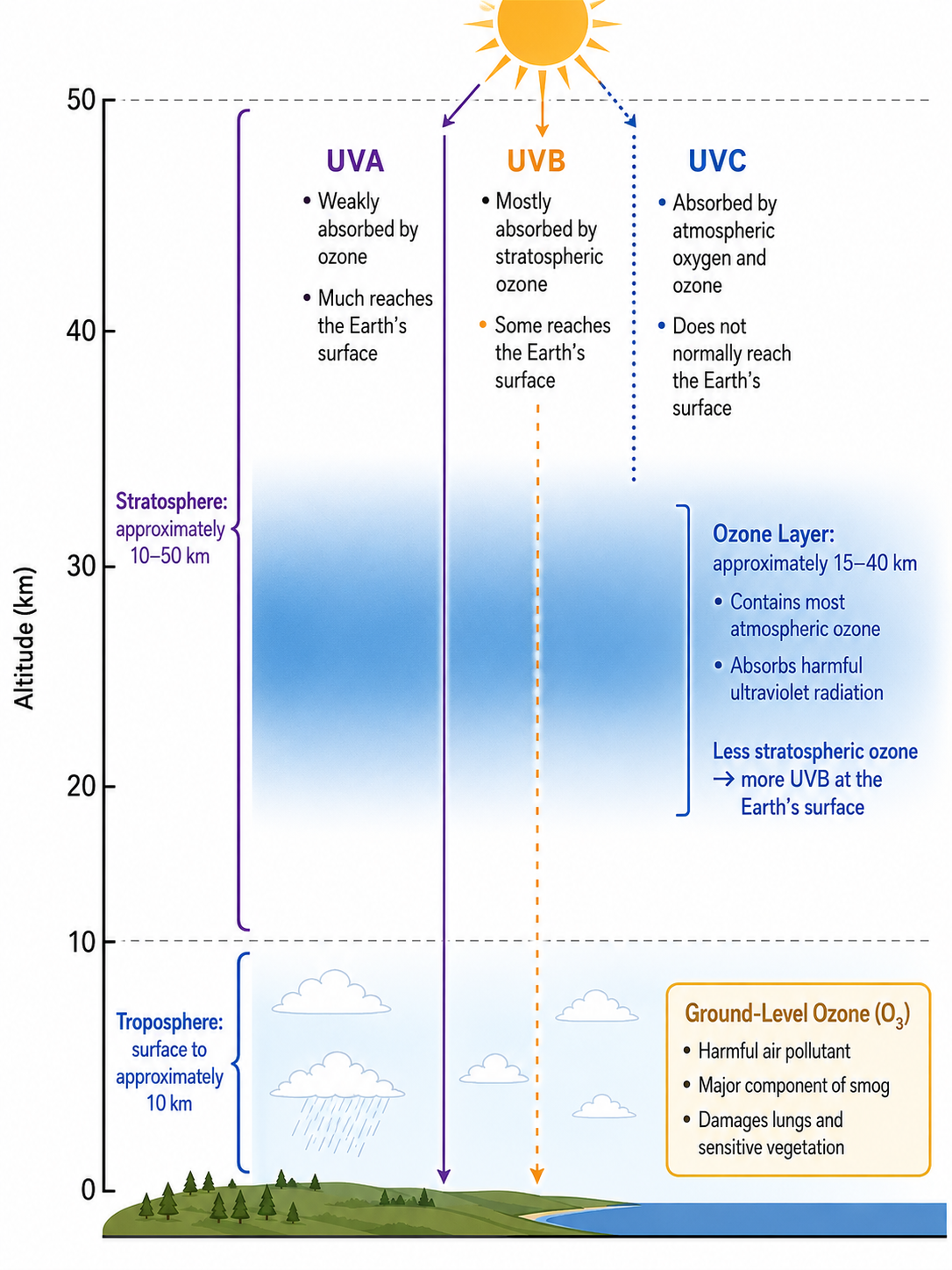
Figure 2.1.1 – Ground-level ozone, the stratospheric ozone layer, and the filtering of solar ultraviolet radiation.
AI-generated instructional figure: It may contain visual inaccuracies. Use the accompanying lesson text and cited authoritative sources to verify technical and regulatory details.
EPA 608 Exam Focus
What Students Must Remember
- Ozone is ; ordinary molecular oxygen is .
- Ground-level and stratospheric ozone are the same molecule in different atmospheric locations.
- Ground-level ozone is a harmful pollutant and a major component of smog.
- Stratospheric ozone is protective because it absorbs harmful ultraviolet radiation.
- The ozone layer lies in the stratosphere, not in the troposphere.
- The ozone layer is a broad concentration region, not a solid shell.
- About 90 percent of atmospheric ozone is located in the stratospheric ozone layer.
- UVA is weakly absorbed by ozone.
- UVB is mostly absorbed by ozone, although some reaches the surface.
- UVC is absorbed by atmospheric oxygen and ozone.
- Ozone depletion primarily increases the amount of UVB reaching the Earth’s surface.
- Increased UVB can raise risks of skin cancer, cataracts, immune-system effects, ecosystem damage, and material degradation.
- Ground-level ozone pollution and stratospheric ozone depletion are different environmental problems.
- Ozone depletion and climate change are related in some ways but are not the same problem.
Typical Exam Question Patterns
Students may be asked to:
- Identify the chemical formula for ozone.
- Distinguish from .
- Identify the atmospheric location of the ozone layer.
- Distinguish protective stratospheric ozone from harmful ground-level ozone.
- Identify which UV band is most affected by ozone depletion.
- Identify which UV band is absorbed by oxygen and ozone before reaching the surface.
- Select a health or environmental effect of increased UVB.
- Explain why ozone depletion is relevant to refrigerant recovery and venting controls.
- Recognize that the ozone hole is an area of severe thinning rather than a physical opening.
High-Priority Comparison
| Exam Clue | Best Association |
|---|---|
| Ozone | |
| Ordinary molecular oxygen | |
| Stratosphere | Protective ozone layer |
| Troposphere near the surface | Ground-level ozone pollution |
| Mostly absorbed by ozone | UVB |
| Absorbed by oxygen and ozone | UVC |
| Weakly absorbed by ozone | UVA |
| More surface UVB | Reduced stratospheric ozone |
| Skin cancer and cataract risk | Excessive UV exposure |
| Smog and respiratory irritation | Ground-level ozone |
Common Mistakes and Confusing Points
Mistake 1: Treating All Ozone as Either Good or Bad
Ozone is protective in the stratosphere and harmful when present at elevated concentrations near the ground.
Mistake 2: Confusing Ozone With Ordinary Oxygen
Ozone is . Ordinary molecular oxygen is .
Mistake 3: Imagining the Ozone Layer as a Solid Shell
The ozone layer is a broad region with an increased concentration of ozone molecules. The ozone remains a trace component of the atmosphere.
Mistake 4: Locating the Ozone Layer in the Troposphere
Most protective ozone is concentrated in the stratosphere, above the troposphere where people live and weather occurs.
Mistake 5: Assuming the Ozone Layer Blocks All Ultraviolet Radiation
UVC is absorbed, most UVB is absorbed, and much UVA reaches the surface. Some UVB also reaches the surface even with a healthy ozone layer.
Mistake 6: Assuming Ozone Depletion Primarily Increases UVA
Ozone depletion primarily increases surface UVB. UVA is only weakly absorbed by ozone.
Mistake 7: Confusing Ground-Level Ozone Pollution With Ozone-Layer Depletion
Ground-level ozone forms through pollution chemistry near the surface. Ozone-layer depletion is loss of protective ozone in the stratosphere.
Mistake 8: Treating the Ozone Hole as an Empty Opening
The ozone hole is a region of extremely low seasonal ozone concentration, not a physical opening through the atmosphere.
Mistake 9: Treating Ozone Depletion and Climate Change as Identical
The problems have different primary mechanisms and effects, even though some chemicals and atmospheric processes connect them.
Mistake 10: Memorizing One Exact Altitude as a Regulatory Boundary
Atmospheric-layer heights vary. The approximate ranges are used to understand the location and function of the ozone layer, not as Section 608 regulatory thresholds.
Concept-Check Questions
Question 1
What is the chemical formula for ozone?
A.
B.
C.
D.
Question 2
Where is most protective atmospheric ozone located?
A. In the stratosphere
B. At ground level in urban smog
C. Inside the troposphere below all weather systems
D. Only over Antarctica
Question 3
Which statement correctly compares ground-level ozone and stratospheric ozone?
A. They are different chemical substances with unrelated formulas.
B. Ground-level ozone is protective, while stratospheric ozone is a respiratory pollutant.
C. Both are , but their effects differ because they occur in different atmospheric locations.
D. Ground-level ozone forms the ozone layer during hot weather.
Question 4
Which ultraviolet band is most directly increased at the Earth’s surface when the stratospheric ozone layer is depleted?
A. UVA
B. UVB
C. UVC
D. Infrared radiation
Question 5
Which statement about UVC is most accurate?
A. It passes through the atmosphere almost unchanged.
B. It is absorbed by atmospheric oxygen and ozone before normally reaching the Earth’s surface.
C. It is the main component of visible sunlight.
D. It is produced only by ground-level ozone.
Question 6
Which human-health effect is associated with increased exposure to UVB?
A. Reduced risk of cataracts
B. Elimination of skin-cancer risk
C. Increased risk of skin cancer and cataracts
D. Improved immune-system function in every person
Question 7
Which environmental effect can result from increased UVB exposure?
A. Increased protection of phytoplankton from sunlight
B. Reduced damage to outdoor polymers
C. Damage to sensitive plants and aquatic food-web organisms
D. Elimination of material degradation
Question 8
Which statement best describes the ozone layer?
A. A solid shell of pure ozone surrounding the Earth
B. A broad region of the stratosphere containing most atmospheric ozone
C. A layer of ground-level smog extending to the top of the atmosphere
D. A permanent empty opening over Antarctica
Answers and detailed explanations will be provided in
2.11 - Answers and Explanations.md.
Section Summary
Ozone is a reactive three-oxygen-atom molecule written as .
The same molecule has different environmental effects depending on its location:
- Ground-level ozone is a harmful air pollutant.
- Stratospheric ozone forms the protective ozone layer.
The ozone layer is a broad ozone-rich region of the stratosphere, approximately to above the Earth’s surface. It absorbs much of the Sun’s harmful ultraviolet radiation.
The most important ultraviolet distinctions are:
- UVA is weakly absorbed by ozone.
- UVB is mostly absorbed by ozone, although some reaches the surface.
- UVC is absorbed by atmospheric oxygen and ozone.
Loss of stratospheric ozone allows more UVB to reach the Earth’s surface. Increased UVB can affect human health, plants, aquatic ecosystems, biogeochemical cycles, and outdoor materials.
This scientific foundation explains why refrigerants and other chemicals capable of contributing to ozone depletion must be controlled. The next section develops the chlorine- and bromine-catalyzed ozone-destruction process.
References
Current EPA and Government Science Sources
-
U.S. Environmental Protection Agency, Information on Ozone and Ozone Depletion, accessed August 6, 2026.
-
U.S. Environmental Protection Agency, Basic Ozone Layer Science, accessed August 6, 2026.
-
U.S. Environmental Protection Agency, Frequently Asked Questions about the Ozone Layer, accessed August 6, 2026.
-
U.S. Environmental Protection Agency, Health and Environmental Effects of Ozone Layer Depletion, accessed August 6, 2026.
-
U.S. Environmental Protection Agency, Ground-Level Ozone Basics, accessed August 6, 2026.
-
National Oceanic and Atmospheric Administration, Scientific Assessment of Ozone Depletion: 2022 — Twenty Questions and Answers About the Ozone Layer, accessed August 6, 2026.
-
National Aeronautics and Space Administration, Ultraviolet Waves, accessed August 6, 2026.
-
National Aeronautics and Space Administration, Aura’s Ozone, accessed August 6, 2026.
EPA 608 Examination Reference
- U.S. Environmental Protection Agency, Section 608 Test Topics, accessed August 6, 2026.